
Australia and the United States have signed a landmark critical minerals deal, with both countries to contribute at least US$2 billion (A$3.1 billion) to rare earths projects over the next six months.
The framework, announced on Monday (Tuesday AEDT), is designed to secure a critical minerals supply chain for semiconductors and defence technologies as China tightens control over global supply.
Prime Minister Anthony Albanese signed the deal with US President Donald Trump at the White House, describing it as a “really significant day” for both nations.
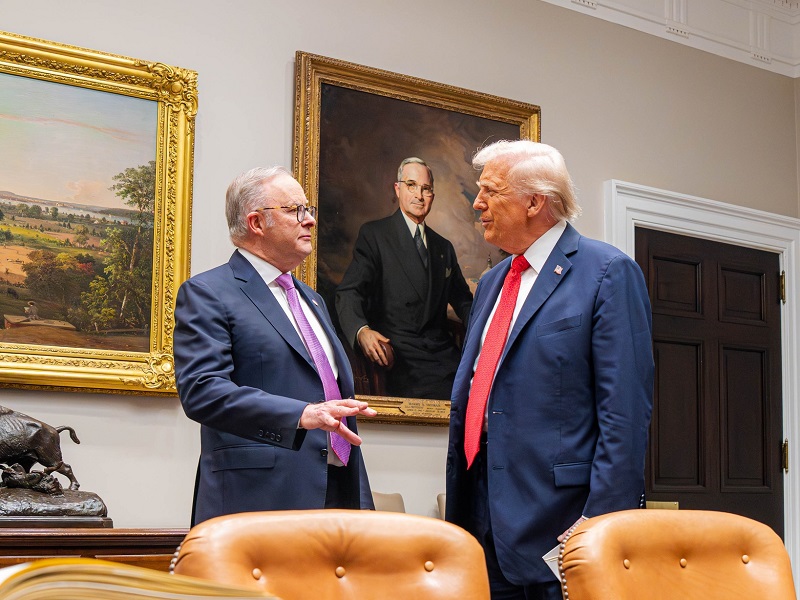
Mr Trump, who was meeting with Mr Albanese for the first time since his election win last year, said the agreement had been “negotiated over a period of four or five months” and would significantly boost supply.
“In about a year from now, we’ll have so many critical minerals and rare earths that you won’t know what to do with them,” he told reporters at the signing of the agreement on Monday.
Critical minerals are vital for everything, from smartphones and fibre optic cables to electric vehicles, batteries and solar panels. They are also essential for defence technologies.
Both Australia and the US will invest more thanUS$1 billion towards a US$8.5 billion pipeline of priority projects, which include the Alcoa-Sojitz Gallium Recovery Project in Wagerup, Western Australia.
Australia will provide up to US$200 million in concessional equity finance for the project, while the US Department of War will also provide an equity investment. Both investments include a right of offtake.
The funding will be used to construct a “100 metric-ton-per-year” gallium refinery, a fact sheet circulated by the White House said, which is expected to provide up to 10 per cent of global gallium supply.
Australia will also invest US$100 million in the Arafura Nolans project in the Northern Territory, which is expected to produce 5 per cent of global rare earths. It is unclear if this in addition to the National Reconstruction Fund’s $200 million investment in January.
A US-Australia Critical Minerals Supply Security Response Group will also be established to identify priority minerals and supply vulnerabilities, and develop a plan to accelerate the delivery of processed minerals.
Australia also agreed to enhanced defence “burden sharing” and a series of defence investments, including US$1.2 billion worth of autonomous underwater vehicles from US defence tech startup Anduril.
It is unclear whether this is in addition to last month’s $1.7 billion Ghost Shark contract, which paves the way for a large fleet of unmanned military submarines with strike capabilities.
Do you know more? Contact James Riley via Email.