
The Fourth Industrial Revolution (4IR) isn’t just another technological shift. It is a fundamental reimagining of human potential that mirrors the Renaissance of the 15th and 16th centuries. Both eras represent profound transformations in how humans understand themselves, create knowledge, and shape their world.
This argument presents compelling parallels that reveal we’re living through a new Renaissance disguised as an industrial revolution.
In 1440, when Johannes Gutenberg’s printing press began producing its first pages in Mainz, Germany, few could have imagined they were witnessing the beginning of a transformation that would reshape human consciousness itself.
The mechanical reproduction of text fundamentally altered how knowledge moved through society, who could access it, and what people could imagine doing with it.
The printing press didn’t cause the Renaissance on its own, but it became the Renaissance’s circulatory system, pumping ideas through Europe with unprecedented velocity.
We may be living through something similar. The Fourth Industrial Revolution is a term that conjures images of robots on assembly lines and AI optimising supply chains, but we might be something far more profound than its industrial branding suggests.
Beneath the talk of automation and productivity gains, we’re experiencing a transformation that more closely resembles the cultural and intellectual explosion of the 15th and 16th centuries than any previous industrial shift.
This isn’t just about new technologies. It’s about new ways of being human.
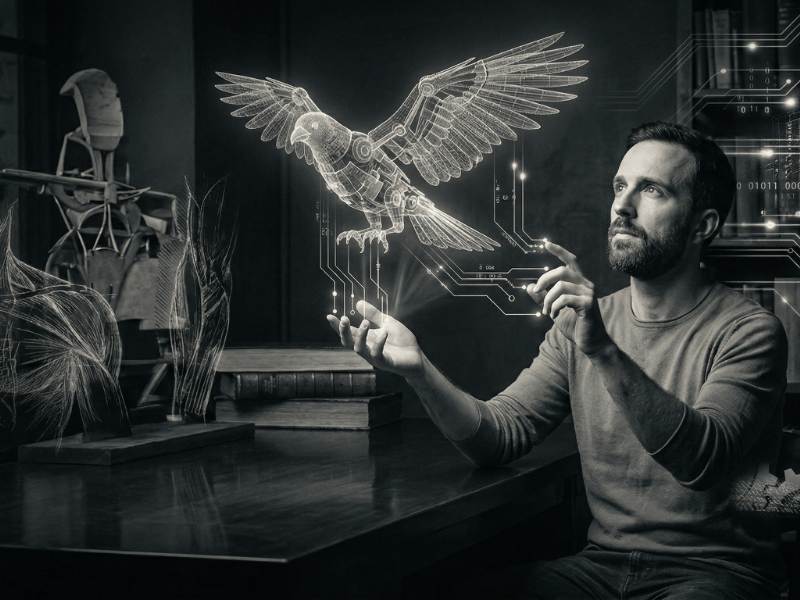
Both eras share five defining characteristics: a convergence of disciplines that breaks down artificial boundaries, a democratisation of knowledge and creative tools, a redefinition of human identity and potential, an explosion of creative possibilities through new mediums, and a fundamental shift in worldview from mechanical to interconnected.
The question isn’t whether we are in a new Renaissance, but whether we can recognise what’s happening in time to shape it wisely. The parallels between these two eras aren’t vague similarities, They’re specific, structural, and worth examining one by one.
Printing and Authorship
Comparing the internet to the Gutenberg press has become a well-worn analogy, but it captures only part of the transformation. The printing press democratised distribution. The same text could reach thousands rather than dozens.
The internet democratised publishing. Anyone could share their writing without gatekeepers. But AI pushes the entire project up a level, democratising creation itself.
When language models can generate coherent, stylistically sophisticated text on virtually any topic, the author’s traditional role fragments. The skill of arranging words into persuasive arguments, compelling narratives, or clear explanations becomes partially automated.
This isn’t just a more efficient typewriter. It’s a technology that challenges the fundamental notion of authorship as the uniquely human act of turning thought into language.
The parallel to Renaissance anxieties is striking. When printed books proliferated, scribes worried about their obsolescence. When vernacular translations of the Bible spread, religious authorities worried about interpretation without mediation.
Each democratisation created both opportunity and crisis. The same dynamic is playing out now, compressed into years rather than decades. If anyone can produce professional-quality writing with AI assistance, what distinguishes the writer? What remains distinctly human in the act of composition?
Yet the Renaissance offers a potentially optimistic reading. The printing press didn’t eliminate authors, it created an explosion of them. More people writing, more ideas circulating, more experiments in form and content.
Perhaps AI will do something similar, shifting the writer’s role from pure production to curation, editing, and the kind of creative judgment that remains stubbornly difficult to automate.
The question becomes not “Can you write?” but “What’s worth writing?” Not technical execution but taste, judgment, and the capacity to recognise what matters.
Polymaths
For another parallel, consider the polymath. Leonardo da Vinci embodied the Renaissance ideal: artist, scientist, engineer, anatomist. He saw no contradiction in studying the mechanics of bird flight one day and painting the Mona Lisa the next.
Da Vinci’s notebooks illustrate this seamless integration, with architectural designs coexisting directly alongside anatomical studies and complex mathematical puzzles.
This fluency was not accidental; the era’s advancements demanded it. For example, perspective drawing necessitated a deep understanding of mathematics, and realistic anatomical representation required dissection and study.
Today’s innovators like Elon Musk, Jennifer Doudna, and Demis Hassabis blend disciplines freely: AI meets biology, neuroscience meets computer science, art meets algorithms.
Doudna’s work on CRISPR requires understanding chemistry, biology, ethics, and increasingly, computer science for predicting genetic outcomes. Hassabis brings neuroscience to bear on artificial intelligence at DeepMind.
These aren’t dilettantes dabbling in different fields; they’re people who understand that the most interesting problems don’t respect departmental boundaries.
Humanism
The original Renaissance was catalyzed by Humanism, a philosophical shift that placed humans at the center of intellectual and moral inquiry, celebrating human agency and potential.
This challenged the medieval worldview, which often portrayed humans as fundamentally limited and awaiting divine salvation, replacing it instead with a confident and exuberant belief in individual human capacity.
We’re redefining what it means to be human through AI, genetic engineering, brain-computer interfaces, and virtual reality.
The questions we’re asking are fundamentally Renaissance questions: What are the limits of human potential? Can we transcend our biological constraints?
What does it mean to be conscious? The transhumanist and post-humanist movements, whatever one thinks of their specific proposals, are engaged in the same project as Renaissance humanists: reimagining the human condition.
Resources
The Medici family and other patrons funded artists and thinkers, creating an infrastructure for creativity that didn’t require creators to immediately justify their work through market returns.
Today, lower barriers to entry mean less funding is required to create meaningful work. Sam Altman has noted that we’re entering an era where small teams might build billion-dollar companies.
The democratisation isn’t just in who can access tools, but in what’s possible with minimal resources.
Exploration
Geographic exploration has given way to digital, inner, and outer space exploration. The Age of Discovery opened new worlds and trade routes, expanding the European conception of what existed beyond their borders.
We’re exploring inner space (consciousness studies, the quantum realm, the microbiome). We’re exploring outer space with renewed ambition (Mars missions, asteroid mining, the search for exoplanets).
And we’re exploring cyber space, creating the metaverse and virtual worlds that exist nowhere and everywhere simultaneously.
The convergence of scientific disciplines is accelerating. CRISPR allows us to edit life itself with something approaching the precision that Renaissance sculptors brought to marble.
We’re not just studying genetics; we’re rewriting the code of life. Quantum computing forces us to reimagine the fundamental nature of information and computation, questioning assumptions that have held since the invention of the transistor.
Synthetic biology programs living organisms like computers, turning cellular machinery into programmable substrates. Neurotechnology creates direct interfaces between mind and machine, promising or threatening to dissolve the boundary between thought and action.
The knowledge revolution extends beyond scientific disciplines. The open source movement represents collective intelligence building cathedrals of code.
Complex systems like Linux, are maintained by thousands of contributors who have never met, working on shared problems without traditional hierarchical organization. MOOCs mean that anyone can learn from MIT, Stanford, or Harvard for free.
AI tutors promise personalised education for billions, adapting to individual learning styles in ways that human teachers, constrained by class sizes and time, cannot.
Cultural transformation is happening in ways that feel simultaneously alien and familiar. TikTok creates shared global experiences, where a dance trend in Mumbai can become a global phenomenon within hours.
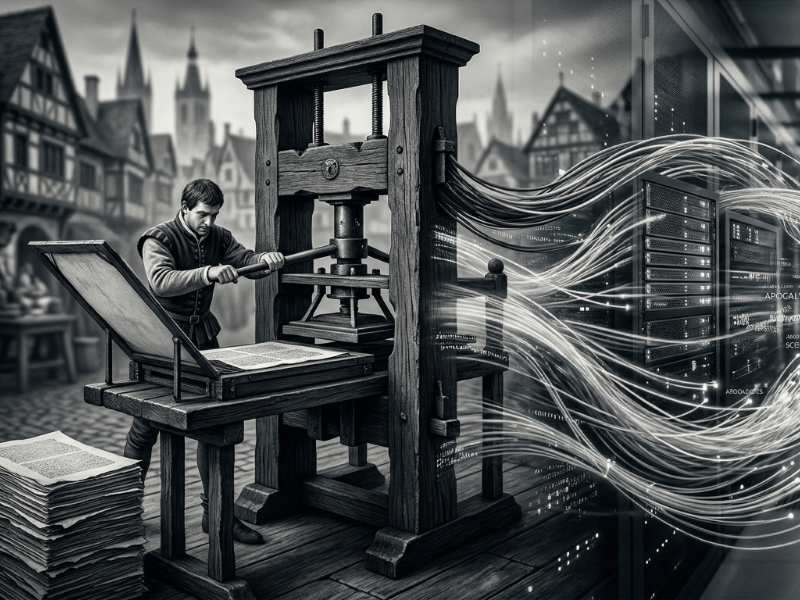
Memes, a form of cultural transmission, are evolving and mutating faster than traditional media. People explore multiple selves in digital space (the gaming avatar, the professional LinkedIn persona, the pseudonymous Twitter voice).
DAOs (Decentralized Autonomous Organisations) are creating new types of human organization that don’t fit neatly into existing categories of corporations, non-profits, or cooperatives.
The first Renaissance is often remembered primarily as an artistic movement, yet Renaissance art was never separate from science, mathematics, or philosophy. Perspective drawing required mathematics. Anatomical accuracy demanded dissection and study. The great works emerged from a synthesis of knowledge.
We’re entering an era where everyone becomes a creator, augmented by AI tools that lower the technical barriers to expression.
A person with no coding experience can now build prototyped applications. Someone with no formal art training can create sophisticated visual designs. Musicians can compose complex arrangements without knowing notation.
The tools are becoming extensions of intent rather than gatekeepers requiring years of technical mastery. This doesn’t diminish the role of expertise, but it changes who can participate in creation and what kinds of synthesis become possible.
The Renaissance Mindset in Modern Context
Renaissance artists studied anatomy, architects were mathematicians, philosophers were scientists. The boundaries we now take for granted between domains like art and science would have seemed bizarre to someone in 15th century Florence.
The same mind that designed cathedrals also solved problems in hydraulics and studied the properties of light.
Today, bioengineers are artists growing leather in labs, creating materials that don’t just mimic nature but engage with it at a fundamental level. Data scientists are storytellers, using visualisation not just to display information but to create narratives about patterns and possibilities.
Programmers have become philosophers, grappling with AI ethics, consciousness studies, and questions about what it means for something to understand or to know.
Entrepreneurs are social architects, designing platforms that shape behavior at scale, often with more influence than traditional policymakers.
The tool revolution mirrors the Renaissance expansion of techniques and materials. Oil paints, telescopes, and printing presses enabled new forms of expression and discovery.
The camera obscura changed how artists understood perspective and light. Each new tool didn’t just make existing work easier; it made new kinds of work conceivable.
GPT models and other large language models are new tools for thought and creation, augmenting human cognition in ways we’re still learning to understand. VR and AR provide new canvases for experience, allowing the creation of environments that don’t exist in physical space.
Blockchain creates new systems for trust and value exchange, potentially transforming how we coordinate economic activity. Biotechnology turns life itself into a medium in which living cells serve as the substrate for creation.
Democratisation is accelerating faster than in the original Renaissance. Books slowly spread literacy and ideas over centuries. The printing press was invented in 1440, but universal literacy wouldn’t arrive for hundreds of years. A smartphone now gives anyone instant access to essentially all human knowledge.
GitHub enables anyone to contribute to global projects, where the quality of your code matters more than your credentials. 3D printers let anyone become a manufacturer, producing custom objects without the need for factory infrastructure. Social media makes everyone a publisher, collapsing the distance between creator and audience.
The Term Industrial Revolution Undersells The Moment
The term Fourth Industrial Revolution focuses our attention on automation and efficiency, economic productivity, technological systems, and industrial transformation. These are real and important changes. But the framing misses the deeper story.
We’re experiencing consciousness evolution, where AI forces us to understand our own minds more clearly. When we build systems that can write, reason, and create, we’re compelled to articulate what we mean by understanding, what distinguishes genuine creativity from sophisticated imitation.
The New Renaissance is defined by a creative explosion in which the traditional lines distinguishing the consumer from the producer has become practically meaningless.
Everyone is becoming an augmented creator. Identity transformation is underway as we navigate physical, digital, and virtual selves, maintaining coherence while playing different roles across different realms.
The meaning revolution questions fundamental assumptions about work, purpose, and community. What happens when vast categories of employment become obsolete? What gives life meaning when productivity is no longer scarce?
The cosmological shift may be the most profound. We’re moving from seeing ourselves as inhabitants of an isolated planet to understanding ourselves as a potentially spacefaring species.
This isn’t just about rockets and Mars colonies. It’s about fundamentally reimagining our place in the universe and our relationship to time. A space-faring civilisation thinks in different timeframes, plans across generations, and develops different ethical frameworks.
Infrastructure for the New Renaissance
All of this requires new infrastructure that supports our continued evolution. We need to develop a new substrate, a new kind of “operating system upon which the New Renaissance will flourish.
Looking to the first Renaissance, it’s clear that new infrastructures fostered by cities were crucial. We believe that this will continue to be the case.
Current smart city initiatives often feel more like surveillance capitalism than Renaissance workshops. These systems are optimising for efficiency and control rather than human flourishing.
They treat citizens as data points to be monitored, traffic as something to be managed, and resources as something to be allocated. The technology serves the system, not the people.
The City OS vision differs fundamentally: it’s not about monitoring citizens but about citizens collectively shaping their environment. It’s the difference between a city that watches you and a city that listens to you, learns with you, and evolves through your participation.
Cities in the original Renaissance, places like Florence, became engines of creativity through physical proximity that enabled collaboration. The workshops and studios were close enough that techniques spread through observation and conversation.
Patronage systems concentrated resources in ways that made ambitious projects possible. Guilds organized knowledge transfer, ensuring that expertise passed from master to apprentice. Public spaces fostered serendipitous encounters.
The artist bumping into the mathematician in the piazza led to conversations that cross-fertilised disciplines.
The City OS could transform contemporary cities into living laboratories where every citizen becomes both researcher and subject, contributing data and insights while also benefiting from the collective intelligence.
It creates distributed intelligence networks that amplify collective creativity, allowing insights to emerge from patterns that no individual could perceive. It enables democratic innovation platforms in which community values shape technology rather than technology imposing values on communities.
From Worker to Renaissance Citizen
The conventional question is: “What skills do workers need?” The New Renaissance asks: “What capabilities do flourishing humans need?” The difference shapes everything that follows. A worker-centric view treats people as inputs to be optimised, asking how humans can be made to fit into increasingly automated systems.
It assumes the goal is efficient deployment of human capital within existing structures. Workers execute tasks, adapt to systems, and solve defined problems. The framework is fundamentally industrial, a system for managing resources, minimising friction, maximising output.
A Renaissance-citizen view flips this. It asks how to build systems that amplify human flourishing.
Renaissance citizens create meaning, design systems, and imagine new possibilities. This shapes what we optimise for and what we consider success. More radically, the New Renaissance might create something resembling a new aristocracy, though one vastly more distributed than history has ever seen.
In a recent interview, Andre Karpathy, an early contributor to OpenAI’s Chat GPT points out that historically, when pockets of individuals were freed up from labor, sometimes a kind of aristocratic flourishing emerged – freed from physical labor to pursue philosophy, art, and governance.
AI could free broad populations from cognitive labor in much the same way, creating space for what we might call elevated human pursuits. This raises challenging new questions. What does it mean to be freed from labor when work has been central to identity and dignity?
The aristocrats of the Renaissance cultivated refinement, but they also cultivated idleness and decadence. Not everyone who is freed from necessity uses that freedom well. In addition, the economic model remains unclear.
If AI is doing most of the cognitive work, how do resources get distributed? Universal basic income is one answer, but it’s far from certain that such systems will be implemented equitably or at all.
If AI handles optimisation, analysis, and routine creativity, humans might focus on pursuits that are meaningful precisely because they can’t be optimized or automated: building deep relationships, grappling with ethical complexity, creating art for reasons that have nothing to do with productivity, engaging in democratic deliberation, cultivating wisdom rather than just accumulating knowledge.
The New Renaissance doesn’t need workers trained for specific tasks. It needs humans capable of continuous reinvention, comfortable with ambiguity, fluent in multiple forms of intelligence, and committed to collective flourishing. These aren’t simply skills for employment. These are capabilities for a new form of citizenship where everyone is simultaneously creator, critic, and curator of shared reality.
The Renaissance Returns
The Fourth Industrial Revolution is a misnomer that captures the economic surface but misses the civilizational depth of our moment. We are living through a new Renaissance. This time we may see a rebirth of human potential amplified by technology.
The parallels aren’t perfect; history never simply repeats. But the pattern is recognisable enough to be instructive. The original Renaissance transformed medieval Europeans into modern humans. It changed what they knew, how they thought, what they valued, and how they understood their place in the cosmos.
This New Renaissance is transforming modern humans into something we don’t yet have adequate language for, a hybridised, interconnected, potentially multiplanetary species with the power to inform its own evolution and create new forms of consciousness.
Five hundred hours of video are uploaded to YouTube every minute. Five billion people are online compared to 50,000 who could read in 1450.
Scientific knowledge now doubles every twelve months rather than every century. Two billion content creators exist today versus a few hundred Renaissance artists.
The Linux kernel has over 20,000 contributors from more than 100 countries. More than 200 billion in venture capital is deployed annually compared to the entire Medici fortune of approximately 460 million in adjusted dollars
Two hundred million people are enrolled in online courses. Twenty-seven million software developers work worldwide.
Yet numbers alone don’t capture the transformation. The Renaissance wasn’t fundamentally about the quantity of art produced or books printed. It was about a shift in humanself-conception, a recognition of new possibilities, a willingness to question inherited assumptions.
The art, science, and philosophy that emerged were symptoms of this deeper change.
The artists, scientists, and thinkers of the original Renaissance didn’t know they were making history. They were simply pursuing what seemed important, interesting, or beautiful, working on problems that captured their imagination.
But we have something they lacked: the capacity to recognise our moment while we’re in it. We can see the patterns, appreciate the similarities, and make choices about what we want to build. We can be active participants in a cultural transformation.
We’re living through a Renaissance measured not in centuries but in decades, not in paintings but in pixels, not in cathedrals but in code, not in isolated workshops but in interconnected cities that think and learn with us.
Unlike our predecessors, we have the privilege and the burden of knowing we’re making history. The question isn’t whether transformation is happening. The question is what we choose to create with it.
Tom Hajdu is founder and CEO at digital infrastructure company Disrupter.
Do you know more? Contact James Riley via Email.