
I live in Perth, often referred to as the world’s most isolated capital city. My work means that I spend a lot of time on planes and I think a lot about systems that keep everything moving safely.
Over recent months, I have found myself coming back to the same thought: Australia needs a better public language for understanding the infrastructure beneath AI, cloud and supercomputing. The Prime Minister’s recent national address on “AI in Australia’s interests” offered a timely reason to put that analogy into words.
Australians already understand critical infrastructure in transport, energy and communications. We understand that airports are not airlines, that freight hubs are not passenger terminals, that some aircraft are built for long haul and others for specialised missions, and that none of it works without trained people, clear rules and long-term investment. But when it comes to advanced computing, much of the public conversation still collapses everything into vague ideas like “data centres” or “the cloud”.
That is no longer good enough.
The systems now shaping our economy, our science and increasingly our security are more varied, more strategic and more physical than that word suggests.
Commercial data centres are the airports: the secure facilities providing power, cooling and physical infrastructure where digital systems are housed. The cloud we use is more like the global airlines: flexible, scalable and useful, but largely designed, owned and operated by large international providers whose commercial logic and strategic control sit elsewhere.
AI adds another layer again. Training a large language model is not the same as using one. Training frontier AI requires immense specialised compute, energy and data, akin to a factory building a new aircraft class. Inference, by contrast, is the day-to-day use of those trained models to answer questions, generate text or analyse images at scale. Inference is often measured in ‘tokens’ (units of data), just as aviation tracks passengers and traffic to understand demand and system load. Training and inference are different tasks, with different economics, different hardware and different policy implications.
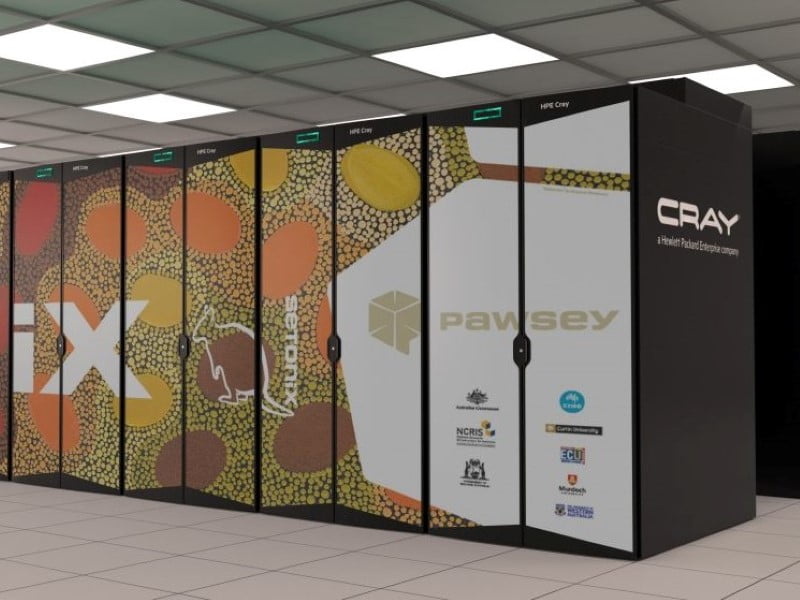
Then there is national high-performance computing. Facilities like the Pawsey Supercomputing Research Centre (which I manage in Perth) are not simply another commercial service in the mix. They are closer to specialised national laboratories with advanced hardware and expert teams, built to run the most demanding scientific and strategic workloads, close to the data they depend on, under clear governance and with public-purpose objectives, not commercial ones.
That distinction matters because of the kind of work these facilities carry. Some of it demands answers that are exact and repeatable, the certainty you need when the results inform a medical treatment or a climate decision. Some relies on data so large, so valuable or so sensitive that it makes more sense to bring the computing power to the data than to move the data around the world. And some of it simply shouldn’t, or can’t, leave the country at all. This is why sovereign capability is not a luxury.
It is also work Pawsey already does at scale. Our flagship supercomputer, Setonix, the most powerful research supercomputer in the Southern Hemisphere and among the greenest in the world, delivered more than a billion hours of computing to over 1,600 researchers in 2025 alone.
A genetic analysis that once took a medical researcher about a year can now be done in around five hours; medical research institutions use Setonix to model cancer and analyse sensitive genomic data, work that must be exact, repeatable and secure. Others are using it to build the most detailed climate projections ever produced for Western Australia, looking ahead to 2100 to help governments and communities plan and adapt. This is national capability in practice, not theory, and it is exactly the kind of capability now moving to the centre of government policy.
That shift is becoming more pronounced, not less. In his address last week, the Prime Minister made clear that AI policy is now about more than innovation in the abstract. It is also about national standards, data centre obligations, water and energy use, copyright, security and a whole-of-government framework intended to ensure AI works in Australia’s interests. The establishment of an Office of AI within the Department of the Prime Minister and Cabinet reinforces the point: this is no longer a niche technology conversation. It is a national capability conversation.
But infrastructure is only half the story.
An airport without pilots, engineers, air traffic controllers and safety systems is just a building. Advanced computing is the same. National capability depends not only on machines, but on skilled people: computational scientists, data specialists, software engineers, system architects and research technologists who know how to run complex workloads, optimise performance, manage risk and turn computing power into useful outcomes.
Pawsey describes its role not just in terms of computing infrastructure, but expert support and training for thousands of Australian researchers. That matters because capability is not only what a country can buy; it is what it can operate, improve and sustain.
This is why Australia needs to think of advanced computing as a system of critical infrastructure and services, not a collection of products. We need commercial data centres. We need cloud. We need AI training and inference capability. But we also need sovereign, research-grade computing infrastructure that cannot simply be purchased as a commodity from overseas when strategic needs arise. That capability has to be built over time, governed carefully and linked to universities, industry and the national interest.
If Australia wants to shape the future of AI, science and digital industry, rather than simply consume what others build, then this distinction matters. Computing Australia’s future is not only about adopting new tools. It is about understanding the underlying system well enough to invest in the parts that only Australia can provide for itself.
Do you know more? Contact James Riley via Email.