
Eighty-three million dollars. That is the net present economic value independent modelling attributes to the outcomes generated through Quantum Australia’s national programs over the last two years.
Quantum Australia, the national centre for quantum growth, brings together researchers, industry, startups, investors and governments across the country to help build sovereign quantum capability and economic value here on home soil.
Consultancy firm Avant Group calculated the $83.1 million figure. This captures economic value generated through Quantum Australia’s national programs, including grant and industry funding mobilised and commercial activity supported.
And the same independent modelling separately calculated the return on Commonwealth investment: $2.15 in direct economic benefits for every $1 invested, rising to $6.87 in total economic activity once wider flow-on effects are counted.
These are clearly results that are not to be sniffed at. But what is even more unusual here is what the modelling covers.
Australian quantum value figures are often derived as projections of what the sector might be worth a decade or two in the future. But this one is based on outcomes already generated through Quantum Australia’s programs. More importantly, it provides an early measure of the economic value that can be created when research, industry, government and capital are connected through a national ecosystem.
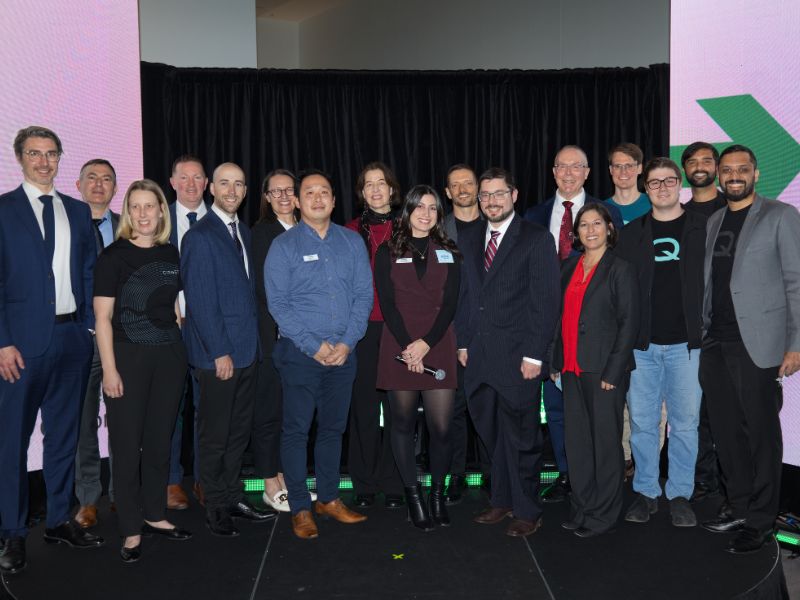
Those results were released by Quantum Australia at Australia’s first national quantum showcase at New Parliament House in Canberra earlier this month, in front of the investors and government representatives who will help decide what comes next for Australia’s national quantum effort.
So what has been done to turn Australian quantum research into commercial value?
The six quantum startups who presented at the showcase can help us to answer that question.
From laboratory to term sheet in 20 weeks
Research strength becomes commercial value when someone carries a use case from a laboratory conversation to a funded project and, where appropriate, to a venture an investor will back.
That is a core part of the work that Quantum Australia was established to do as Australia’s national centre for quantum growth.
In just two short years, Quantum Australia has helped to catalyse 110 industry-research partnerships and supported 66 quantum use cases across critical industries, 50 of which have been funded, drawing over $56 million into industry-linked research and facilitating over $50 million in grant funding.
These programs work because they are connected to a national ecosystem: wherever an opportunity emerges, it can be connected to the best research capability, infrastructure, industry expertise, customers, capital and commercialisation support it needs to grow, regardless of where in the country those resources are located.
Its programs are building a growing pipeline of quantum companies and commercialisation opportunities here on home soil, through deliberate sequencing.
The approach starts from problems that end users have confirmed are worth solving, putting potential customers in view before these companies even have products.
Quantum Australia’s pre-accelerator program NewQ helps early-stage quantum researchers, innovators, and entrepreneurs fast-track their ideas from concept to commercial reality, testing potential applications, customer demand and pathways to market for these early quantum ideas.
Quantum Australia’s non-equity accelerator program NextQ takes ventures from technical validation to commercial and investor readiness in just 20 weeks, including with project funding attached.
Five months ago that pipeline had produced six companies. It has now produced 15.
The six who presented their investment-ready technologies at the Quantum Australia Showcase are each addressing specific industry problems.
FeBI Technologies uses quantum sensing to give clinicians a low-cost, accurate measure of a patient’s true iron status, while QFactorial cuts kilometres, fuel, and operating costs for freight, logistics, and mining operators.
SpaceCoLAB’s briefcase-sized system sends data as quantum states, so any interception collapses the link and triggers an alert, while Quantum Lock lets operators of power stations and satellites prove whether a device has been tampered with.
Gridstate Photonics plug-and-play module helps photonic quantum computers correct errors fast enough to run at scale, as Cirnetiq builds the amplifiers that make the faint signals inside quantum computers readable.
Critically, QFactorial and Quantum Lock also travelled the full length of both NewQ and NextQ, highlighting the value of these programs in driving the growth of the companies who participate.
Holding that ecosystem together takes coordination across every state and territory, and a national community of practice of 4,100 people spanning industry, research, government, and investment. Quantum Australia has also just established a team in Canberra at the Australian National University, further strengthening its connections with the national capital and federal government.
It’s clear that the pipeline is doing its job. The challenge now is ensuring Australia continues to have a national, neutral platform that connects the ecosystem, translates its strengths into economic value onshore, and promotes Australian quantum as one ecosystem to global markets.
Three ways to invest a public quantum dollar
Australia’s quantum companies exist in part because our governments had the foresight to invest early.
Government accounted for 80 percent of all quantum investment in Australia between 2021 and 2024, according to Quantum Australia’s analysis of OECD data. Globally, government funding represented just over 20 percent.
One commitment drives most of that gap. The Commonwealth and Queensland governments put $940 million into PsiQuantum, a single investment large enough to reshape the national figures. Strip it out and the picture is a smaller pool of public money spread across a research base, a startup pipeline, and the programs that connect them.
Private capital alone is unlikely to fund Australia’s quantum ambitions at this stage, so decisions made in Canberra and the state capitals will continue to have an outsized influence on which Australian quantum opportunities are developed and scaled. Three forms of public support are particularly important.
Firstly, government capital and procurement build capability and markets. Large capital investments can put strategic quantum infrastructure on Australian soil, while government investment can provide emerging companies with capital to scale and procurement can create critical early markets
Secondly, research grants build knowledge and people. This is the funding that built Australia’s research depth over two decades, and the reason the country now ranks fifth in the world for quantum talent capacity, with 26 dedicated quantum research organisations and over 60 academic research groups.
And thirdly, national coordination connects the pieces. Platforms like Quantum Australia can connect opportunities with the best research capability, industry expertise, customers, capital and commercialisation support available nationally, while building trusted international partnerships that connect Australian capability to global markets and opportunities. This helps turn Australia’s distributed quantum strengths into industry partnerships, funded use cases and companies like those that presented in Canberra last week.
The potential economic impact of making those connections can be seen in the companies already emerging from the pipeline.
Imagine QFactorial’s optimisation shaving distance and fuel from the 768 billion tonne-kilometres of freight Australia moved in 2020; FeBI’s sensor diagnosing iron deficiency in a GP’s office in a single visit; or Quantum Lock giving critical infrastructure operators proof that equipment has not been physically compromised.
Whether these companies make their way into the industries where they can help millions of people and make millions of dollars, if not billions, depends on many things, but access to capital and customers will be crucial.
All six ventures are still mid-transition, while another NextQ cohort has also been newly recruited, meaning there is still an incredible amount of work to be done.
We know the risk: a venture that cannot raise its next round locally may raise it overseas, then hire, manufacture, and pay tax where the money came from. That is how a country funds the science and rents out the industry.
But if Australia continues investing in the research base, pursuing the strategy that targets global quantum leadership by 2030, and maintaining the national coordination that connects research capability to industry, capital and markets, we may actually have a shot at building on these early economic outcomes and realising the $6.1 billion quantum is projected to add to Australia’s GDP by 2045.
As Quantum Australia’s chief executive Petra Andrén says: “The next challenge is maintaining that momentum through continued national coordination and sustained investment so these companies have the opportunity to scale in Australia, create jobs here, and compete globally”.
Australia has done the maths on two years of Quantum Australia’s national programs, and the answer was beyond promising. The goal now is to connect Australia’s quantum strengths nationally, translate more of them into economic value, and take them to the world as one Australian ecosystem.
The conversation continues at the Quantum Australia Conference in Sydney on 17-18 February 2027.
This article was produced in partnership with Quantum Australia.
Do you know more? Contact James Riley via Email.