
As the Department of Home Affairs’ head of national security, Hamish Hansford has access to “exquisite” intelligence with which to identify and better understand worst-case security scenarios.
This is the superpower of governments, he says. The ability to access national, economy-wide data from a wide variety of sources that are not available to individual companies or organisations, to identify vulnerabilities and mitigate risk.
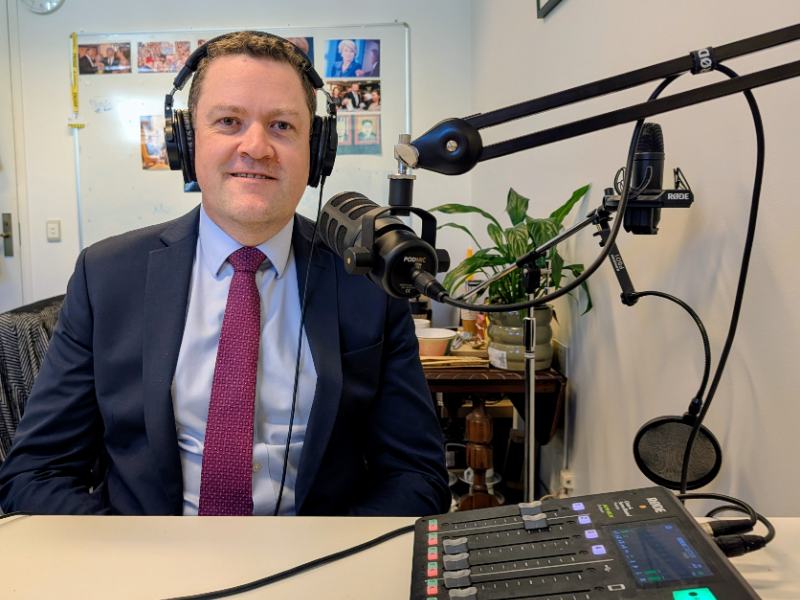
In this episode of Delivery: A GovTech podcast, Mr Hansford discusses his approach to risk, and how government is managing the dramatic changes being wrought by artificial intelligence.
This is a fascinating interview. With so much going on in the world right now, and against the backdrop of sharpening geopolitical competition, the opportunities and challenges of technologies like AI are rolled up in the same thing.
These are circumstances that can be both good and bad at the same time but need to be managed regardless.
When the US Trump administration switched off access to Anthropics Fable/Mythos frontier AI models, it gave the Australian government “pause” on supply chain and sovereign control issues.
And the reliance of the Australian government on a small handful of US strategic tech providers is a potential concentration risk. But the fact that US technology is so entwined within Australia’s national security is also a strength.
“That’s the role of the government, to say what’s the worst-case scenario, what does that look like, how do we mitigate against that, and how do we see vulnerabilities that an individual company or agency cannot see,” Mr Hansford said.
“That’s kind of our superpower. We’re looking across [the society] as a giant risk mitigator and trying to identify where there are areas [of vulnerability] that we need to particularly focus on,” he said.
Mr Hansford says there are many working definitions of sovereignty, but at its most basic relates to understanding what materially might impact the function of an agency, or a department or organisation, and building diversity into that system.
The government does think broadly and collectively about sovereignty and about access and control.
Which is why the US government actions over access to Mythos gave so many in our own government “pause for thought”.
Mr Hansford says the US government’s delayed international release of Mythos may have been done for very good security reasons – but regardless, “people are now thinking about ‘how do I deploy AI in the most secure way, noting that it may not always be available in the way that other products are”.
“So yes, I think it has given us pause for thought,” he said.
As for unwinding the depth of the technology relationships with US tech providers in the way that some European governments have started to do, Mr Hansford says that’s not going to happen.
The Department of Home Affairs identified areas where they had the greatest concentration risk, and broadly it was with American tech firms.
But far from unwinding the reach of those relationships, Mr Hansford said a plan was embarked to build better relationships with each of those companies.
“Our first digital resilience agreement was with Microsoft because it’s so pervasive across the Australian government ecosystem and Australian industry,” he said.
“It has given us a perspective that we need to have a better personal relationship with each of those big providers, given the disproportionate impact that they might have if they were subject to an outage.”
“The reality is that a lot of the American providers are so deeply embedded in our economy, that it is unrealistic to look at alternatives.
“The Australian economy will always be built on American technology, given how important it is. But of course, diversity is also good. It’s just something we have to manage, but we will always have to have a relationship with American tech companies,” Mr Hansford said.
“They underpin our national security. They underpin the functioning of the economy, and they are individually important for how we operate,” he said.
“I think that the Europeans are embarking in one [direction], but Australia, given our size and scope, I think there’s a different way to manage that risk.”
Do you know more? Contact James Riley via Email.