
North Australian SeaCulture has won Croc Pitch 2026, putting the seaweed startup in line for up to $1 million in venture capital from Paspalis Capital.
The company grows and processes native tropical seaweed into products designed to improve degraded soils, with mine rehabilitation providing its first commercial focus.
For founder and chief executive Alison Duguid, the ambition is to build a network of regional seaweed hubs that can support communities over generations.
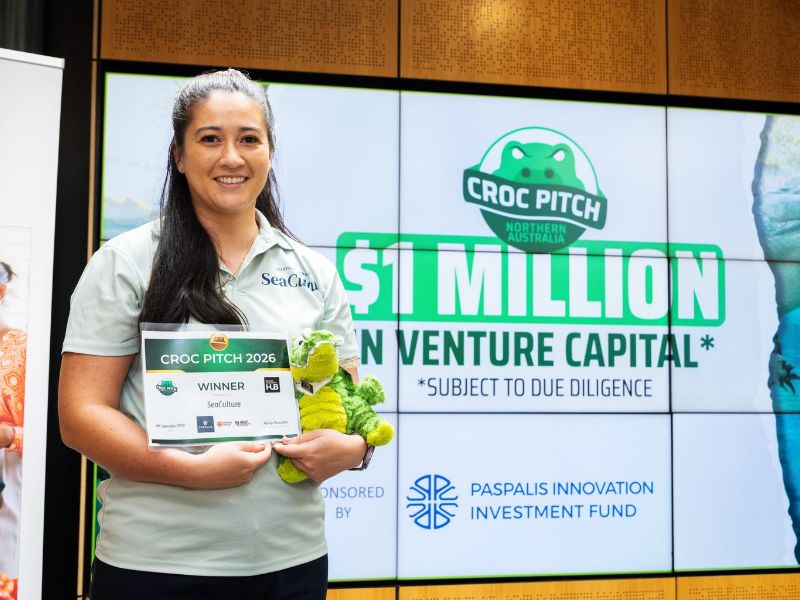
Growing up in Darwin, the chemical engineer saw the economic disruption that followed major projects. She believes locally committed businesses can provide greater continuity
“Those are the businesses that I think make the biggest long-term economic impact in the region,” Ms Duguid said.
SeaCulture’s model would connect mining customers with cultivation and processing operations developed alongside local communities, including Traditional Owner groups interested in owning and operating sites.
The immediate customer problem is the shortage of suitable topsoil for rehabilitating land after mining. Without healthy soil, establishing vegetation can remain difficult even after other closure work is complete.
“There’s just a big lack of availability of that sort of topsoil,” Ms Duguid said.
SeaCulture’s processing technology draws on her PhD research at the University of Western Australia. Early pot trials using Western Australian soils have shown promising revegetation growth, alongside changes in organic carbon, nutrients and the physical properties of soil.
The company has its first cultivation site at Darwin Waterfront Lagoon and paid trials underway with a major miner.
Its next research phase will test whether the results can be replicated using seaweed grown in the north and soils from particular mining and agricultural sites, through planned work with local and national research organisations.
That local validation is central to the commercial approach. Drawing on her experience inside the resources industry, Ms Duguid has structured a pathway from pot trials to field trials and then service agreements, giving customers evidence relevant to their own operations before committing to broader adoption.
Croc Pitch helped SeaCulture explain how that technology would become a sustainable business.
Working with Paspalis investment manager Alex Farrugia, Ms Duguid shifted some of the emphasis from processing and extraction to the proposed model and how revenue would flow between mining customers, SeaCulture and community groups.
“Calling this out as its own standalone piece of our presentation was really, really important,” she said.
“It also showed how we’d thought about the integration of the technology into community for long-term adoption.”
The preparation also helped her concentrate the pitch on mine rehabilitation, giving investors a clear initial business case while leaving room for other products and markets, including gels and pigments.
Hosted by Darwin Innovation Hub, this year’s competition ended with SeaCulture taking the top spot and fellow finalists NatureHelm and Drone-Hand also progressing to due diligence for potential investment.
Ms Duguid described the win as overwhelming, with family, friends and advisers following the pitch and sending so many messages she had to silence her phone.
She believes her longstanding Territory connections helped demonstrate that SeaCulture was committed to building in the north. Those relationships underpin negotiations with local partners, while the region’s tropical waters offer practical advantages for cultivation.
The seaweed species SeaCulture is targeting also prevalent in Indonesia, allowing the company to draw on partnerships there and experience from an established tropical seaweed industry.
The potential investment from Paspalis, subject to due diligence, would initially help increase seaweed production at the Waterfront Lagoon to supply larger field trials while environmental approvals are pursued for other northern sites.
SeaCulture also wants those trials to establish the customer demand needed to support its first pilot processing hub, moving production beyond the laboratory.
Over the next 12 months, the priority is securing agreements with community groups that want to own and operate sites, alongside customers ready to move from field trials into commercial rehabilitation.
“For us, success in 12 months’ time will be to have secured the agreements for the establishment of the hubs,” she said.
She is inviting aquaculture operators and Traditional Owner groups across Northern Australia to discuss where the model could work.
“We’re keen to continue conversations about developing these hubs in regional areas,” Ms Duguid said.
Learn more about North Australian SeaCulture at https://seaculture.au/.
This article was produced by InnovationAus.com in partnership with Paspalis.
Do you know more? Contact James Riley via Email.