

Welcome to Delivery: A GovTech Podcast! In this first episode, we talk to the Department of Finance’ chief AI officer Paul Hubbard about the structures and priorities behind the public sector roll-out of AI services.
In addition, Mr Hubbard runs the department’s AI Delivery and Enablement (AIDE), a central function providing whole-of-government support services to the new army of chief AI officers being appointed across departments and agencies.
Paul Hubbard has been a driving force behind the development of the APS AI plan launched last November, and in this episode he spends time talking through the new AI structures within the federal government.
From a standing start 12 months ago, the federal government has made significant progress to building out AI expertise.
When government launched its AI Plan for the Australian Public Service last year, it committed to funding mandatory training for all staff on the responsible use of AI, as well as the appointment of Chief AI Officer’s across all departments and agencies by the middle this year.
The government had already required departments and agencies to have nominated “accountable officers for AI use” the previous year.
“What we’ve already got in every agency is an accountable official for AI, and they’re responsible for the policy on responsible use of AI and government within their agency,” Mr Hubbard told the Delivery podcast.
“That provides that governance framework, the transparency, the reporting, the monitoring and notification of high-risk use cases, things like that.
“The new Chief AI Officer function – with that governance in place – [asks] how do I drive adoption in my agency, and how do I drive it for the purpose of delivering public value?”
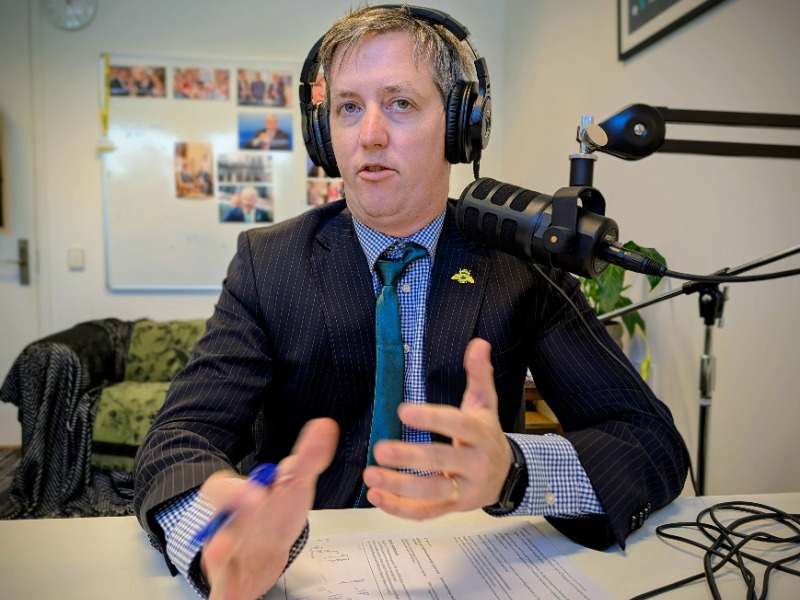
Mr Hubbard is well placed to talk about the challenges, strategies, and expectations of the new chief AI officer cohort being hired across government.
He has also spent time understanding where this emerging AI technology intersects with data, workforce capability, risk, human resources, stakeholder relations, information management, privacy, cybersecurity, and all of the other domains that artificial intelligence touches.
If you are a supplier to government, or a contractor or advisor, this podcast provides some insights into government priorities in the adoption of AI systems and processes.
As part of the role Mr Hubbard is also co-head of the ‘AI CoLab’ initiative that is managed by the department that includes both physical spaces for collaborative exercises (including a node within the Canberra Innovation Network) as well as digital sandboxes for rapid design and prototyping.
“We hosted over 100 workshops last year that were open to everybody, from AI technical experts to workshops on the epistemology of large language models or the representation of gender in AI images,” Mr Hubbard said.
“It’s a place where, if you’re curious about AI, you can find other people who are curious. You can work together and learn what’s happening in SMEs, what’s happening in academia, without the same overheads as more formal, large-scale processes,” he said.
“So, it’s about discovering what’s possible and who’s it possible to do things with?”
“The APS AI Plan does say that we can’t do this alone in government,” Mr Hubbard said. “We can’t try and pretend that we can solve all these problems just by ourselves.”
“In fact, you probably can’t get to safe and responsible AI that delivers for citizens unless citizens are actually involved in that process,” he said.
Do you know more? Contact James Riley via Email.