
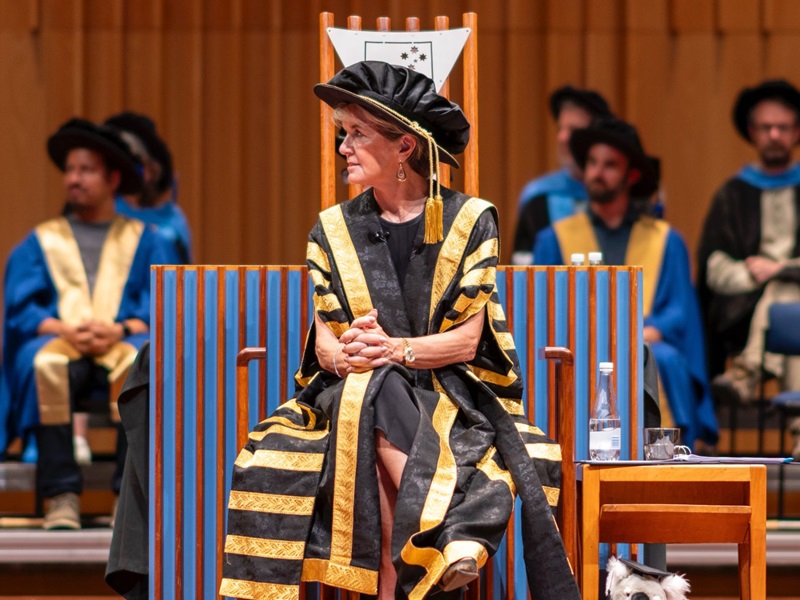
Former Coalition grande dame Julie Bishop has stepped down as Chancellor of the scandal-ridden Australian National University, seven months before her term was due to end.
Ms Bishop has faced ongoing pressure to resign from students’ groups, faculty members and politicians amidst ongoing governance failures at the university, which last year also led to the resignation of vice-chancellor Genevieve Bell.
Announcing her departure on Friday, Ms Bishop said she had been “deeply privileged” to hold the chancellor role, and that she “[continued] to regard the ANU as a truly national treasure”.
The former deputy-leader of the federal Liberal Party was first named to take on ANU’s top job by its board in 2019, six months after her resignation from federal politics.
Ms Bishop’s tenure has included the scrapping of a $250 million cost-cutting measure, which unions estimated could have axed up to 650 jobs, and multiple accusations of misconduct levelled at ANU executives, including Bishop herself. Ms Bishop has consistently denied those allegations.
In a parting shot at detractors, Ms Bishop said her leadership had been subjected to “unprecedented and coordinated interference”, warning Australia’s higher education sector was “at a crossroads of regulatory overreach”.
National Tertiary Education Union ACT division secretary Lachlan Clohesy said Ms Bishop’s resignation was a chance for ANU to restore “calm and stability”.
An independent review of ANU’s financial governance by higher education regulator the Tertiary Education Quality Standards Agency is expected to be delivered this year.
The ANU Council in a statement said pro-chancellor Dr Larry Marshall would serve as interim chancellor until a permanent appointment is made.
The top job at the peak body for Australia’s semiconductor industry is up for grabs following the announcement this week that director Nadia Court will depart the Semiconductor Sector Service Bureau (S3B) after three years.
A respected tech director, Ms Court began her career as a research fellow at the CSIRO, going on to work at defence prime BAE Systems, the Australian National Fabrication Facility (ANFF) and as technical director at the University of Sydney (USyd).
S3B was launched as a joint venture between the NSW government, USyd, Macquarie University, the University of New South Wales, the CSIRO and the ANFF in 2022 to advance the capacity of the national semiconductor industry. Ms Court was its inaugural director.
Ms Court said it had been a privilege to lead S3B through its early stages, and lauded its work “[positioning] semiconductors as an enabling capability for Australia’s economy”.
The ACT government’s new digital, data and IT services directorate has landed top New South Wales public servant Christina Igasto as its inaugural director general.
A digital government and digital health expert, Ms Igasto joined the NSW public service in the COVID, going on to serve on the NSW Health AI Taskforce, the ICT and Digital Leadership Group and as chief digital officer as Service NSW.
Digital Canberra launched last year in response to the findings of a review of the ACT’s public service that its ICT operations remained siloed and at risk of external interference.
The Smart Energy Council has announced senior Labor Party staffer David McElrea will be its next chief executive, succeeding veteran leader John Grimes from May 15.
A former top official at the United Workers Union, Mr McElrea joined the peak green energy industry body in 2025 as its chief advocacy officer.
He has twice served as federal Labor MP Tanya Plibersek’s deputy chief of staff, for two years till 2019 while Ms Plibersek was deputy leader of the opposition, and three years through 2025 during her tenure as minister for the environment.
Federal Energy Minister Chris Bowen paid tribute to Mr Grimes for his leadership of the SEC, saying his 18 years as CEO had built it into “one of Australia’s most respected and effective clean energy organisations”.
Consultancy giant EY has poached Microsoft executive Jo Dooley as its next clients and industries leader for Oceania. Ms Dooley succeeds Selina Short, who announced she would step in as CEO at professional services firm JLL in March.
Ms Dooley’s storied career includes a 17-year stint at IBM, and seven years at Microsoft where she was most recently vice president enterprise.
ANU on Monday announced Professor Stuart Wyithe had been appointed its new deputy vice-chancellor research and innovation.
Professor Wyithe joined ANU’s faculty in 2023 as director of the ANU Research School of Astronomy and Astrophysics on the heels of 20 years with the University of Melbourne, where he had most recently served as the associate dean of research and the head of its physics faculty.
Professor Wyithe succeeds Professor Lachlan Blackhall, who departed ANU in February and is currently independent chair and director of not-for-profit the National Energy Public Key Infrastructure.
The University of New England (UNE) on Thursday launched a new Institute for Strategic Artificial Intelligence to be led by its associate dean of research Professor Amir Karton.
The Institute will partner with UNE’s LabNext70, touted as Australia’s first purpose-built, education-focused AI research and delivery hub, to “[bridge] the gap between blue-sky AI research and real-world strategic impact”, the university said in a statement.
Professor Karton, a former Microsoft researcher, joined UNE as a professor of computational and materials chemistry in 2022.
Home Affairs Minister Tony Burke has empaneled the first national Cyber Incident Review Board, to be chaired by Telstra global chief information security officer Narelle Devine.
The board is a requirement of the national Cyber Security Act and will be tasked with reviewing significant cybersecurity incidents to help industry prepare for future possible cyber attacks.
Other members of the board include Professor Debi Ashenden (director of UNSW’s Institute of Cybersecurity), Valeska Bloch (partner and media and telco specialist at law firm Allens), Jessica Burleigh (CISO at Boeing Australia), Darren Kane (chief security officer at nbn Australia), Berin Lautenbach (global head of information security at Toll Group) and Nathan Morelli (head of cyber security at SA Power Networks).
Artificial intelligence voice-tech firm ElevenLabs has appointed former Salesforce and Slack executive Damian Naughton as its first general manager Australia New Zealand and announced plans for new Sydney headquarters.
Data firm Altis Consulting has nabbed Deloitte specialist director Craig Chapman as its next regional director for ACT.
The director of UNSW’s AI Institute and founder of the Robotics Australia Group Dr Sue Keay has joined the newly empanelled advisory board of the Western Australian AI Hub.
The Australian National Fabrication Facility (ANFF) Queensland Node has appointed University of Queensland Associate Professor Idriss Blakey as its new director.
Melbourne-based medical research not-for-profit the Bionic Institute has appointed long-serving director Philip Binns to chair its board.
Do you know more? Contact James Riley via Email.