
Telstra has switched on the Sydney–Melbourne leg of its long-haul fibre system, meeting a surge in AI-fueled traffic and marking a key milestone in the telco’s $1.6 billion infrastructure program.
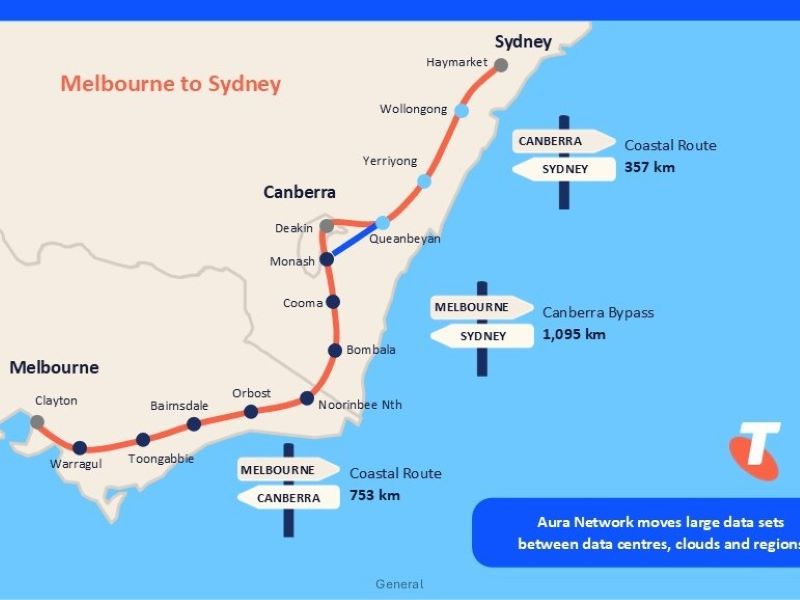
The 1,200 kilometre coastal link, dubbed the Aura Network, connects Australia’s two largest cities with what Telstra says are record transmission rates of 700 gigabits per second on a single fibre channel during live tests and a desktop simulated total capacity of 83.6 terabits per second.
The network is being delivered through Telstra InfraCo, the company’s infrastructure division led by Microsoft Australia’s former boss Steven Worrall.
Telstra is forecasting its Aura Network to reduce network disruptions by around 50 per cent and improve latency by 4 per cent compared with current long-haul systems. It will also incorporate new spectrum and dark-fibre products for hyperscalers and telecom operators seeking higher control and capacity.
The infrastructure will connect over 80 data centres between Sydney and Melbourne and form part of a 14,000-kilometre committed network extending to Adelaide, Perth and Brisbane in Telstra’s planned extension. It uses a dual-path fibre design, an express route for long-distance traffic and a foundation route enabling regional connections.
An Oxford Economics report commissioned by Telstra estimates the Aura Network could add $29 billion to Australia’s GDP by 2040 by lifting productivity and supporting 84,000 new jobs. Adding the additional “routes” — segments that Telstra InfraCo may deploy in future could lift the total economic contribution to $36 billion and 100,000 jobs, according to the analysis.
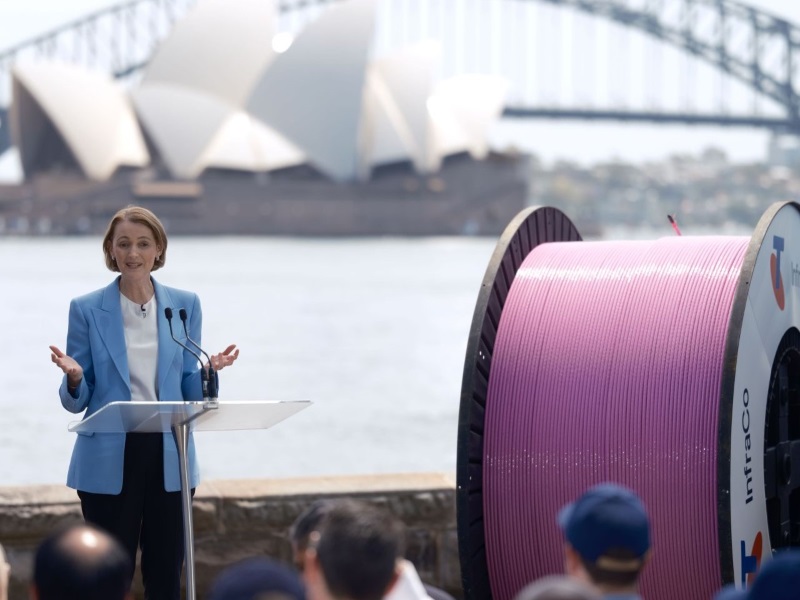
Telstra chief executive Vicki Brady said the network provides “confidence” to Australia’s businesses and communities to share in digital economy opportunities.
“As a nation, we have big priorities: making AI a national focus, building a skilled and adaptable workforce, and securing Australia’s economic potential on a global stage. None of that is possible without world-class digital infrastructure,” she said.
“This network represents a bold ambition. It’s not just fibre in the ground – it is a backbone for innovation, productivity and resilience that helps future proof Australia for decades to come.
At a Tech Council of Australia event in September, Telstra group executive for product and technology Kim Krogh Andersen said the expansion of network infrastructure is critical to support growing demand from data-centre and AI workloads.
“There is a lot of hype about data centres, the compute and AI in the data centres [and] the renewable energy. But these things are not going to happen if they are not connected,” he said on a panel.
Mt Krogh Andersen said the telco’s national fibre rollout has hit regulatory and logistical complexity, including the Canberra to Sydney section alone requiring more than 6,000 approvals.
“Our biggest concern is that this country is not moving fast enough to actually be competitive and set this nation up as a [regional data centre] hub… Because we have the potential but we need to ensure we don’t make it difficult for ourselves,” Mr Krogh Andersen said.
Do you know more? Contact James Riley via Email.