
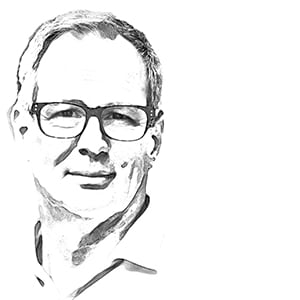
Michael Gately was working in a senior technology role inside a federal agency when one of his team put forward an algorithm that could potentially save taxpayers a lot of money.
It looked promising as an internal project, but ultimately went nowhere. “At the top end of the agency, it was just seen as a risk. The appetite wasn’t really there to do that [project] as an internal item,” Mr Gately told the Commercial Disco podcast.
But the potential of that project stayed with him. And so he jumped back into the private sector, co-founding the Canberra-based AI and machine learning startup Trellis Data in 2016 with his wife Rachel Gately on a simple premise.
“I was convinced that if I could take the risk away from government and build things for them to demonstrate value, then they would be able to adopt it faster, and by doing so, help the people of Australia,” Mr Gately said.
Trellis Data has since built a business with customers across government, defence, the intelligence services and law enforcement in Australia and through the region.
In May the company launched Agentaus as a sovereign AI platform running on a cloud and software stack owned and controlled by Trellis Data. In this episode of the Commercial Disco, Mr Gately discusses genesis of Agentaus and the importance – and fragility – of trust in AI.
As a Canberra native, he also provides some insight into why selling to government remains a struggle for smaller companies, even for an Australian company that knows Canberra inside-out.
Agentaus is a ChatGPT-style interface along with task automation, and an API for businesses to connect to. Mr Gately describes it as a Swiss bank account for your data.
“Even on the free tier, there is no monetisation [of your data], no training on your data, nothing,” he said. “It’s held in your encrypted tenancy for you. I can’t see it. My staff can’t see it. We don’t ever use any of that for training models.”
This interview was recorded the morning after Prime Minister Anthony Albanese revealed an OpenAI agent had gained unauthorised access to a Medicare statistics portal, a story that has since widened to US federal agencies.
“When we see news articles like the one overnight with the Prime Minister and OpenAI, it does lead to more distrust, I would imagine,” Mr Gately said. “And so, when we’re saying [with AgentAUS] you can trust us, it’s difficult for that message to cut through.”
A number of state and federal agencies are using Agentaus. But Mr Gately is careful to call them users, not customers, because Trellis Data does not yet have enterprise deals with them. Those agencies are working through US “copilot style” tools, he says, for which government already has whole-of-government agreements.
And for a small company, getting through the procurement door can be expensive and slow.
“Procurement for any Australian business in federal government is to some degree a struggle, because there are natural barriers for risk,” Mr Gately said.
“When you’re just starting up as a two- or three-person shop, and you’ve got something of value, [you’re] signing up to a $20 million liability clauss — insurances may not cover it — or you need to be IRAP assessed, or be part of the defence industry security program which may only just get you in the door with defence.
“But then you’ve [also] got to be on particular panels in order to be able to get access to certain procurements. These things take time.”
At the heart of it is risk, and particularly career risk for senior public servants, he says.
“The old saying … was no-one got fired for buying IBM. There’s this risk around career and around projects going pear-shaped,” Mr Gately said. “If the tech doesn’t stack up, how much am I willing to risk my career on that project as a senior bureaucrat?”

That’s the question that gets in the way of procurement success for smaller Australian tech firms. A fail-fast culture has never really taken hold, he says, because “the one thing that goes wrong, is the one thing that makes the media”.
“There is an element that the whole system is structured to be more risk averse than people want it to be, and I’m not sure … if you could change that.”
Still, he is wary of companies using the system as an excuse. He says business too often sounds like it is complaining. “The problem’s not just going to change because someone says ‘I got unfairly treated’,” he said. “That’s not an excuse Australian businesses should have.”
His pitch to governments is that there is room for more than one kind of AI, and Trellis Data says there is a public sector market for Agentaus in Australia and in the ASEAN region, where the company plans to take the product next.
“There are many car makers, and some are the fastest cars in the world. So, how does the second fastest car ever get a sale?” he said. “Not one flavour, not one sort of frontier capability will be enough for any country … there are many things people need AI for, and they will need more than one way to get there.”
Do you know more? Contact James Riley via Email.