

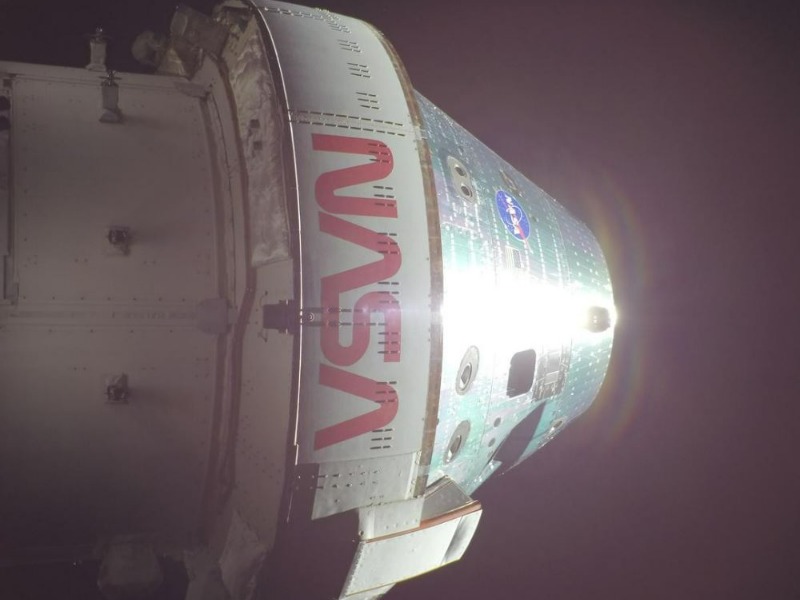
The biggest story in tech in the past week has without doubt been the Artemis II crewed mission to the moon. It has not seemed like this is the case, given the fragmentation of the media and the current geopolitical turmoil that has dominated headlines.
But Artemis II is such an amazing story. The first time the humans have ventured to the moon in more than 50 years. It is astonishing that it has taken so long, but with decades of new technology to draw on, we’re having another crack.
There are echoes from the past in this mission, as it is the same kind of lunar fly-by that took place in 1968 with Apollo 8.
Apollo 8 was the first time human beings had pushed past the gravitational bonds of mother Earth and into the gravitational arms of another celestial body, the moon. It was a stunning moment that was followed by millions across the globe.
There is an amazing book that recounts this unheralded mission, Robert Kurson’s Rocket Men: The daring odyssey of Apollo 8 and the astronauts who made man’s first journey to the moon.
I highly recommend this book, and the parallels to today are self-evident. Apollo 8 took place at the height of the space race as the US and the Soviets threw everything at efforts to get to the moon first.
Apollo 8 was as daring a mission as anything NASA had ever done to that point, and its significance was perhaps clouded by the Apollo 11 landings the following year.
Apollo 8 was launched against a backdrop of turmoil. In fond memories, 1968 was the summer of love, but in reality it was a fractured moment in history characterised by discord and violence.
Vietnam war protests had gathered steam, Martin Luther King was murdered and the civil liberties movement exploded with riots. Robert Kennedy was killed. The Prague Spring saw the Soviet Union crush popular movements in Czechoslovakia and also Poland.
Just as Artemis II launched, a war had been started by the US in Iran, and the war in Europe continued to rage. Discord and violence, again.
The media landscape has changed dramatically since that time. In 1968, the Apollo 8 mission seemed like a shared human experience across the world, with people crouched next to radios and TVs, everyone tuned into the same adventure.
But in 2026, the Artemis II reprise is served up in an atomised media environment. It’s not a shared experience. And for many, whose algorithm is geared differently, they will hardly know the adventure has event begun.
It was the 1968 Apollo 8 mission that sent back the famous EarthRise photos of a small blue planet that really accelerated the global environmental movement.
Artemis II has been sending a constant feed of stunning photography. What impact these will have on our future only the decades to come will tell.
But in case anyone has missed the moment: Artemis II will be remembered as a heroic moment in human space exploration. After 50 years, humans are reaching out. This is what makes America great, and maybe this will be recognised in hindsight.
Stuff to read:
Rocket Men: The daring odyssey of Apollo 8 and the astronauts who made man’s first journey to the moon – Robert Kurson
US, Canadian astronauts capture friendly global attention – InnovationAus
‘Deeply concerning signal’: Australia retreats on global astronomy – InnovationAus
Humanity is heading back to the Moon. Australia isn’t even funding telescopes – The Conversation
Councils sound alarm as data centre approvals outpace infrastructure – InnovationAus
NRF gets new priority focus as global shocks bite – InnovationAus
Charles McHardie takes a deep dive at Services Australia – InnovationAus
Covid lessons: RNA pilot manufacturing gets closer – InnovationAus
Do you know more? Contact James Riley via Email.