
Opening a new Brisbane headquarters and accredited laboratory is a significant step for any growing biotech company. For Genics, the move also shows how far a piece of Australian research has travelled – from solving a disease-detection problem in prawn farming to supporting food producers across more than 60 countries.
Genics’ MultiPath technology grew from research conducted at CSIRO into a persistent challenge for animal-production industries. Conventional diagnostic tests typically screen for one pathogen at a time, even though disease and poor performance are often associated with several pathogens acting together.
The company’s PCR-based technology can identify multiple pathogens in a single test. Its Shrimp MultiPath platform currently screens for 18 common shrimp pathogens simultaneously, giving farmers a more complete picture of disease risk. Genics won the InnovationAus Translation Hero Award in November 2023 for turning this groundbreaking aquaculture research into a globally commercialised solution.
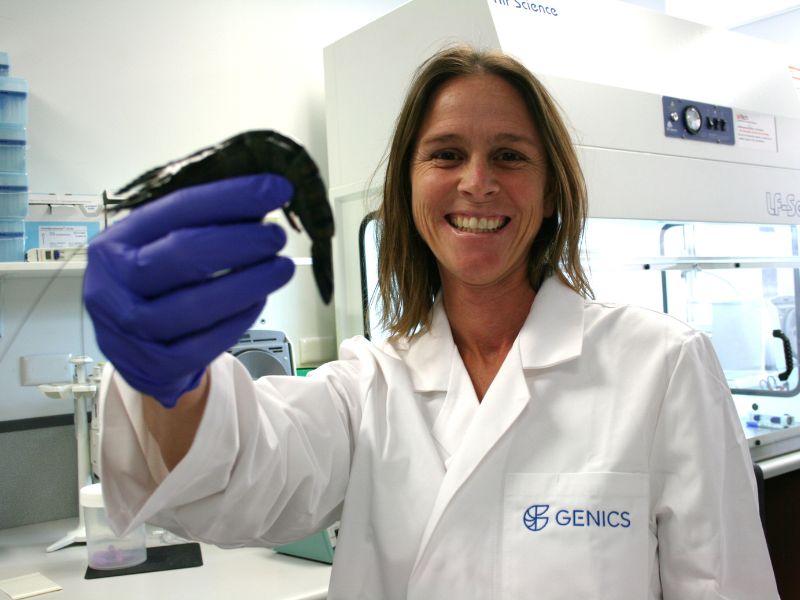
Genics chief executive and managing director Melony Sellars said consolidating these targets into one test substantially reduced the cost of comprehensive pathogen profiling.
This changes testing from something farmers might commission after animals become visibly sick into a tool for statistically meaningful surveillance and early detection.
“Farmers can afford to design a statistically significant sampling plan before they have clinically sick animals,” Dr Sellars said.
“They are then empowered with data on which they can make genuine management decisions that improve biosecurity, stop the spread of disease and improve the profitability and outcome of their crop.”
The first MultiPath panel was developed by CSIRO researchers for the prawn industry. During commercialisation planning, the team concluded that the technology and specialist knowledge required to deliver it would be difficult to transfer through a conventional licensing arrangement.
Several scientists took the concept through CSIRO’s ON Innovation Program, with Dr Sellars volunteering to lead the new company.
“ON Accelerate was mission critical to establishing Genics and to our success in the early days,” she said.
The program helped the team test its product market fit and shift from a research mindset towards communicating customer value, measuring commercial impact and planning for international scale. The relationships created through the program have also endured.
“We still work with people we met during the program,” Dr Sellars said. “It helped us think about how we communicate with clients, how we deliver and measure value, and how we look at long-term global impact.”
After securing the necessary accreditations, Genics began servicing Australian customers before expanding into Latin America, Vietnam, Indonesia, Europe and the Middle East. The technology has also moved beyond aquaculture, with Australian Pork Limited working with Genics to adapt the platform for the pork industry.
Ecuador’s major shrimp industry provides one of the company’s strongest examples of Australian research producing measurable international impact.
Genics now works with some of the world’s largest shrimp producers. Dr Sellars said its technology and pathogen-management programs had helped customers lift baby shrimp production by up to 52 per cent, improve broodstock survival and increase grow-out performance by between 10 and 15 per cent, depending on the pathogens involved.
The company’s new Spring Hill headquarters gives it greater control over the next phase of this growth. The facility includes Genics’ own accredited laboratories, equipment and development capability, allowing it to manage intellectual property (IP) internally and return commercial data to customers more quickly.
Its digital systems also connect farmers in international markets with sample shipping, laboratory workflows and end-to-end traceability in Australia.
“It unlocks our ability to explore more novel biotech solutions and continue to push the envelope on how far we can take our technologies,” Dr Sellars said.
But building an international biotechnology company from Australia also has its challenges. Distance from major markets was an immediate constraint, compounded by the travel restrictions imposed during the COVID-19 pandemic.
Dr Sellars credits Trade and Investment Queensland and Austrade with providing valuable in-market connections when the Genics team could not travel, helping it meet prospective and existing customers through representatives on the ground.
The more complex challenge is creating an operating and regulatory environment that allows Australian companies to retain their IP and high-value capability locally while serving global customers efficiently.
“It has always been our goal to protect the IP for Australia and for Australian taxpayers,” Dr Sellars said.
She described Australia’s regulatory framework as rigorous and at times restrictive for small companies pursuing international growth. She also pointed to payroll tax and the repeated process of securing certificates of residency in some markets as practical obstacles.
Delays in receiving these certificates can prevent overseas customers from paying Genics for several months of the year, creating an avoidable constraint on cash flow and international trade.
Dr Sellars believes governments, regulators and the research sector need to work together earlier when globally significant technologies emerge, developing pathways that preserve appropriate controls while removing unnecessary commercial bottlenecks.
Genics’ progress suggests Australia does not lack research capable of creating global impact. The larger opportunity is to strengthen the pathway around that research – from market validation and founder capability to regulation, investment and export support – so more Australian ideas can become internationally significant companies without having to leave Australia to do it.
This article was produced in partnership with CSIRO’s ON Innovation Program.
Do you know more? Contact James Riley via Email.